The Little Forest Mage collection brings the popular Pop Mart character to chargers, power banks and other everyday accessories.
Nov 20, 2026
In a step toward virtually unhackable networks, KT and LG Electronics have transmitted and restored text and image data by encoding information directly onto quantum particles rather than conventional digital signals, the telecom operator said Friday. The technology is called quantum secure direct communication (QSDC). It differs from quantum key distribution (QKD), the more established form of quantum cryptography. QKD uses quantum signals only to share the keys that encrypt a message. QSDC puts the message itself into quantum states, which are fragile physical properties of particles such as photons. Those states are disturbed if anyone tries to intercept them. KT encoded 1,024 bits of image data into quantum signals, sent them and restored the image at the receiving end. It also used the same system to transmit text data. The two companies have been working together since signing an agreement in 2025 to develop next-generation quantum internet technology. KT built the transmitting and receiving equipment and the communication procedures. It also developed the core technology that con
Bone AI, a Korean defense technology company, is joining a government-backed project to develop domestically made semiconductor technology for disaster detection, with plans to test an artificial intelligence (AI)-powered sensor system on its wildfire-monitoring drones. The company said Friday it will participate in a 10.75 billion won ($7.9 million) research and development project led by Daegu University under the Ministry of Science and ICT's 2026 Science and Technology Innovation Support Program. The project, scheduled to run through 2030, brings together 10 industry, academic and research institutions, including Bone AI subsidiary Dmakers. At its core is the development of a multisensory module that combines data from smoke, flame and gas sensors to identify potential hazards at industrial sites and other locations. The system is designed to reduce reliance on foreign sensors and AI chips by using domestically developed semiconductor technology. Rather than transmitting video and sensor data to ground-based computers for analysis, the AI chip will process information near the sensors
Hanwha Solutions’ Wire & Cable division is expanding its extra-high-voltage cable materials portfolio after passing validation tests in the extra-high-voltage alternating current transmission (HVAC) segment. The company plans to diversify its global customer portfolio and broaden materials supply across a wide range of applications, including power plants, transmission networks and large-scale renewable energy projects. Hanwha Solutions announced on Sept. 29 that its cross-linked polyethylene (XLPE) insulation and semiconductive materials for 500-kilovolt HVAC cables passed a technical validation test, known as a Type Test, conducted in partnership with Chinese cable manufacturers Qingdao Hanhe and TBEA. The test was conducted under the supervision of the Shanghai National Center of Testing and Inspection for Electric Cable and Wire, a certification body affiliated with the Shanghai Electric Cable Research Institute, with key evaluation criteria including insulation performance and long-term reliability under extra-high-voltage transmission conditions. With this achievement, Hanwha Sol
Samsung Electronics on Friday promoted three executives to president in its chipmaking Device Solutions (DS) Division, signaling a generational shift in leadership by elevating executives who spearheaded record semiconductor earnings. The company said Friday it promoted Executive Vice President Hwang Sang-joon to head of its memory business unit and president. Jo Sang-yeon, executive vice president and head of Device Solutions America, was promoted to president and head of the System LSI Business, while Lee Jong-myung, executive vice president and head of process development at the Semiconductor Research Institute, was promoted to president and chief technology officer of the DS division. The company also named President Choi Won-joon, chief operating officer of its Mobile Experience (MX) business under the Device Experience (DX) Division, as the head of the business. Following the reshuffle, Samsung Electronics' two CEOs — DS Division Head and Vice Chairman Jun Young-hyun and DX Division Head and President Roh Tae-moon — will hand over their concurrent roles as heads of the Memory B
HD Hyundai Heavy Industries said Friday a U.S. maritime delegation visited its shipyard to discuss cooperation in shipbuilding, military logistics and port infrastructure. The delegation, led by Mark D. Johnson, deputy administrator of the U.S. Maritime Administration (MARAD), toured the shipyard in Ulsan, about 360 kilometers southeast of Seoul, on Thursday. MARAD, an agency under the U.S. Department of Transportation, oversees maritime transport of military supplies during national emergencies and supports port infrastructure development. The visit came as Washington pushes to rebuild its domestic shipbuilding industry under its "Bridge Strategy," which seeks to leverage the shipbuilding expertise and production capacity of allies while expanding its own industrial base. Last month, HD Hyundai signed an agreement with U.S. engineering and construction firm Kiewit to establish a joint venture to build a shipyard in the United States. Construction is scheduled to begin next year, with full-scale operations targeted for 2029.
Sometimes, last-minute in-store shopping might be your best option.
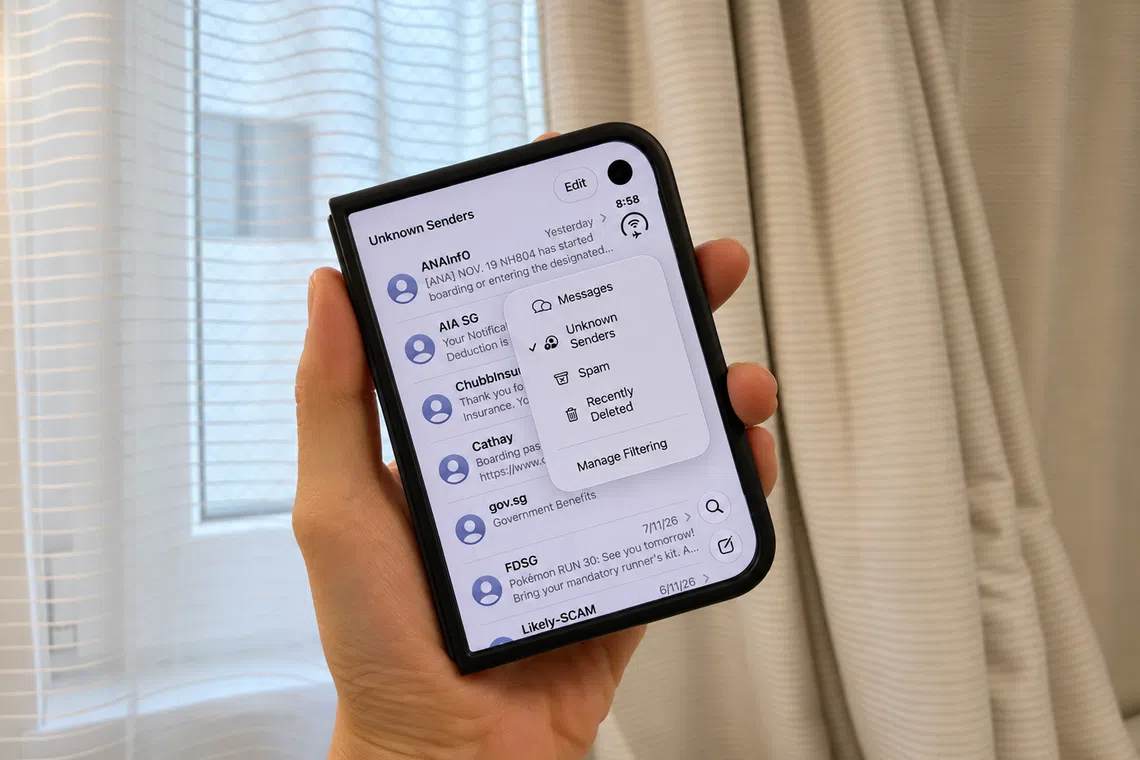
From blocking suspicious links to warning users about unfamiliar numbers, Apple’s latest iOS update is making life a little harder for scammers.
Nov 19, 2026
G-STAR, South Korea's largest game exhibition, kicked off its three-day run on Thursday, bringing together game developers, content creators and fans from around the world in the southern port city of Busan, the event's organizer said. More than 1,200 companies from 41 countries are participating in the event, which runs through Saturday at the BEXCO convention center in the city, some 325 kilometers south of Seoul, the organizer added. An opening ceremony was attended by Culture Minister Chae Hwi-young, Busan Mayor Jun Jae-soo, and executives from game companies, including Kim Chang-han, chief executive officer of the South Korean game publisher Krafton Inc. Chae pledged strong government support to help elevate G-STAR into a globally recognized game exhibition. "The game sector is such an important industry (for South Korea), and something our country is good at," he said, adding that G-STAR is a key part of the country's journey toward becoming a world leader in the industry. Despite the absence of major South Korean game publishers Nexon Co. and NC Corp., which served as the event's m
Growing opposition to power-hungry artificial intelligence (AI) data centers in the United States is raising uncertainty for Korean companies that have expanded their businesses around the country’s infrastructure boom, as Democratic gains in the recent midterm elections raise the prospect of tighter regulation and cloud the outlook for future projects. Local communities’ concerns over electricity bills, water consumption and the cost of expanding power grids could translate into greater regulatory scrutiny, particularly in states that account for a large share of planned U.S. data center construction. The possible shift could have implications for Korean suppliers across the AI infrastructure chain, from memory chipmakers to manufacturers of transformers, cables and energy storage system (ESS) battery makers, many of which have secured major contracts tied to the expansion of U.S. data centers. “If data center construction is delayed, canceled or scaled back, exports by companies in related industries — semiconductors, transformers, cables, electrical equipment and facilities
Mercedes-Benz Korea is bringing a roomier electric SUV with a driving range of up to 435 kilometers to domestic showrooms, expanding its next-generation electric vehicle lineup with a model designed to balance everyday practicality and long-distance performance. The company said Thursday it would launch the all-new electric Mercedes-Benz GLB, with customer deliveries beginning Nov. 25. The GLB 250+ electric, priced at 69.9 million won ($52,400), is the third next-generation electrified model introduced by Mercedes-Benz Korea this year, following the electric CLA and GLC, both launched in October. Built on Mercedes-Benz's Modular Architecture, the SUV features an 85-kilowatt-hour lithium-ion battery and delivers up to 435 kilometers on single charge under Korean certification standards. Its electric motor produces 272 horsepower and 340 Newton-meters of torque, accelerating from zero to 100 kilometers per hour in 7.4 seconds. An 800-volt electrical architecture supports DC fast charging at up to 320 kilowatts, adding as much as 260 kilometers of driving range in 10 minutes. The redesigned m
Korea plans to establish standards for small drone batteries used in civilian and military sectors to make them compatible in size and performance with U.S. standards, the defense ministry said Thursday. The move comes as Seoul is working to establish uniform standards for batteries used in small drones, an emerging asset in modern warfare, to boost their compatibility and reliability while meeting both commercial and military demand. The rules will be drafted based on existing U.S. drone standards, covering the battery dimensions and performance testing methods for small drones, the ministry said in a release. The move reflects Seoul's efforts to better align with U.S. drone standards widely adopted by its allies and partner countries. The government plans to publish a public notice Friday to gather feedback from related industries and experts, aiming to enact the standards in the first half of next year. Standardizing core drone components is expected to help the military secure a stable battery supply chain amid growing demand for drones in wartime and boost the domestic drone ecosyste
P&G Korea, the local unit of U.S. consumer goods giant Procter & Gamble, is donating 20,000 Pampers diapers to families facing financial and social hardships, extending its support for vulnerable children and single-parent households ahead of the year-end holiday season. The donation was made through the Salvation Army Kettle Campaign, with the diapers set to be distributed to Duri Home, a residential facility for single-parent families, other Salvation Army childcare facilities and households raising young children in need. Duri Home provides accommodation and support for single parents raising children younger than 3, helping families establish stable living conditions while preparing for independent lives. Alongside the donation, employees from P&G Korea's Pampers team visited Duri Home on Nov. 12 to volunteer in childcare and facility maintenance, helping create a more comfortable environment for children and their caregivers. "Diapers are an essential everyday necessity for families raising young children, and we hope this donation will ease some of their financial burden and provid