How Modern Warehouses Are Maximizing Storage Capacity Without Expanding
Oct 27, 2026
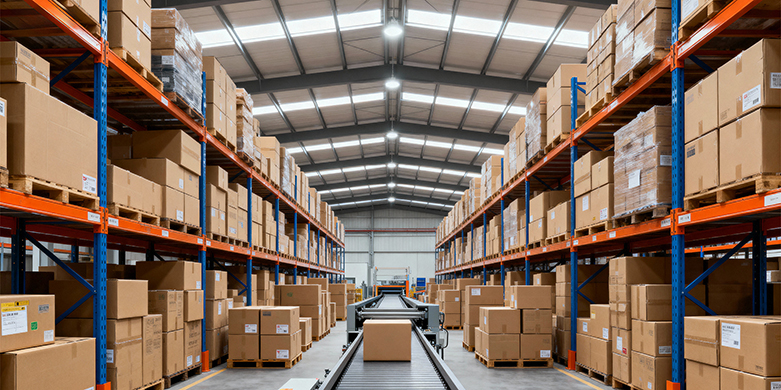
Guangzhou, Guangdong Oct 27, 2026 (Issuewire.com) - For any Warehouse Racking System & Storage Mezzanine Manufacturer, one of the central questions in today's logistics market is straightforward: how can a warehouse store more inventory without adding floor space? As land, construction, operating, and labor costs pressure distribution networks, many operators are looking first at the buildings they already have. The answer is increasingly found in better use of height, denser pallet layouts, more precise SKU zoning, and storage systems designed around actual material flow.
Capacity is no longer measured only by floor area. It is also shaped by usable cubic volume, pallet positions, pick faces, aisle requirements, forklift travel, and the ability to adapt storage zones as inventory changes.
Turning Warehouse Height Into Usable Capacity
One of the most direct ways to increase capacity is to use vertical space more effectively. Floor stacking can leave much of a building's clear height unused and make stock access difficult. Properly engineered Warehouse Racking converts that height into organized storage positions while maintaining defined load levels and handling routes.
Selective pallet racking remains common because every pallet position can be accessed directly. It suits warehouses with many SKUs, frequent stock rotation, or mixed product profiles. HEDA SHELVES also supplies VNA systems for facilities that need pallet selectivity while narrowing aisles and fitting more rack rows into an existing building.
For high-bay facilities storing smaller items, mezzanine systems can add working levels without extending the footprint. Rack-supported, shelving-supported, cantilever, and structural steel mezzanines can be configured for storage, manual picking, packing, sorting, or mixed operations.
Increasing Density by Reducing Aisle Space
Aisles are essential for movement, but they also consume floor area. Modern warehouse design therefore asks how much aisle access each inventory group actually needs.
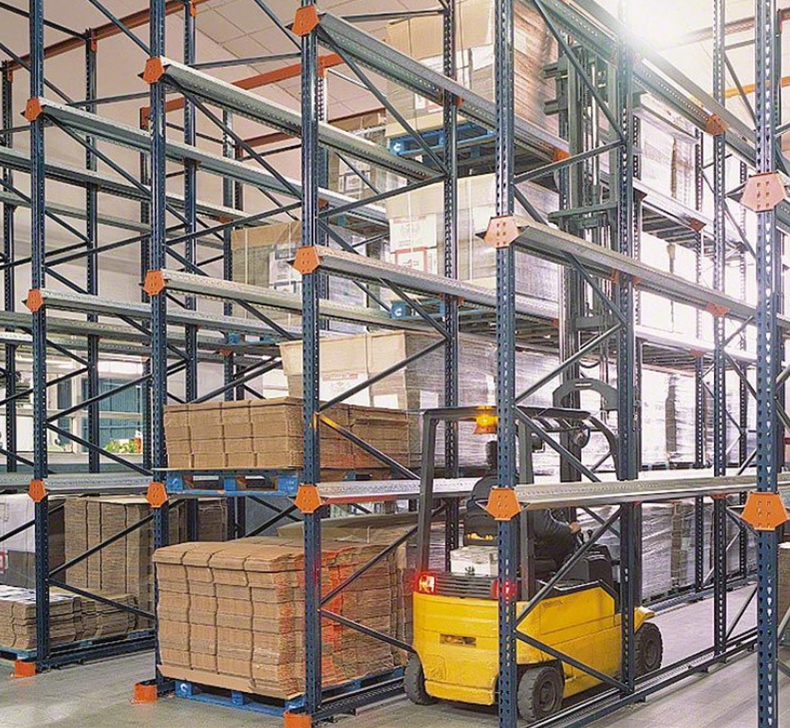
Drive In Warehouse Racking creates deep storage lanes and reduces the number of access aisles. It is generally suitable for larger quantities of the same or similar SKUs, especially where a LIFO method fits the inventory profile. Cold storage, food and beverage, manufacturing, and bulk distribution are common applications.
Radio shuttle systems use a shuttle cart to move pallets within rack lanes, reducing the need for forklifts to enter deep channels. Depending on layout, they can support FIFO or LIFO operations. Push-back and gravity-flow systems offer other approaches where turnover and throughput requirements differ.
High density should not be treated as an isolated goal. A warehouse can gain pallet positions but lose efficiency if the rack type does not match SKU variety, turnover, replenishment frequency, or handling equipment.
Combining Pallet Storage With Picking and Work Areas
Many warehouses need more than pallet storage. E-commerce, spare parts, retail distribution, and light manufacturing may require pallet reserve stock alongside piece picking, sorting, or packing.
Storage mezzanines make it possible to separate functions vertically. Instead of using all floor space for Warehouse Pallet Racks, palletized inventory and forklift movement can remain at ground level while upper floors handle smaller-item storage and manual operations.
A HEDA SHELVES automotive parts project in Thailand used an approximately 9-meter-high, three-level mezzanine arrangement. The ground level was planned for pallet storage and forklift activity, while upper levels supported manual picking and organized storage of spare parts and accessories. This zoning uses the same building volume for different handling methods without forcing them into one traffic pattern.
In Mexico, another project used a three-layer shelving-supported mezzanine with shelving reaching about 13 meters. The layout created multiple usable levels in a high-bay warehouse, with HEDA SHELVES providing on-site engineering guidance during installation.
Matching Warehouse Pallet Storage Racks to Inventory Behavior
Before selecting Warehouse Pallet Storage Racks, operators need to understand pallet dimensions, unit loads, SKU count, turnover, batch size, picking method, forklift type, clear height, columns, fire protection needs, and future growth. Those factors determine whether the warehouse should favor direct access, deep-lane density, narrow aisles, flow-through rotation, shuttle-assisted handling, or a hybrid layout.
A 1,000-square-meter pineapple coldroom project in Malaysia used an 8-meter-high radio shuttle system to improve storage density while reducing unnecessary forklift movement. It was designed for palletized packaged fruit, with load levels of about 1,000 to 2,000 kg. In Ghana, a chemical warehouse used an 8-meter-high, five-level selective system with a specified load capacity of 4 tons per layer for drums and packaged raw materials.
The cases use different technologies because their operating requirements differ. Capacity gains usually come from matching the storage method to the inventory profile, not from maximizing density everywhere.
Engineering and Manufacturing Behind the Layout
Guangzhou HEDA Shelves Co., Ltd, operating under the HEDA SHELVES brand, was founded in 2001 and focuses on pallet racking, industrial shelving, mezzanine systems, and warehouse accessories. Its range includes selective, drive-in, push-back, gravity-flow, radio shuttle, VNA, cantilever, light and medium-duty shelving, and several mezzanine configurations.
For warehouse projects, HEDA SHELVES combines layout planning with manufacturing and installation support. Its project workflow includes CAD planning, 3D rendering, and full warehouse layout design. The company operates a 30,000-square-meter factory with a team of more than 300 people and reports monthly production capacity of up to 30,000 tons, with more than 10,000 warehouse project cases.
Manufacturing control matters because rack performance depends on more than nominal steel weight. Dimensional control, forming, welding, surface treatment, coating, structural design, anchoring, and installation all affect long-term use. HEDA SHELVES describes a production process covering steel cutting, cold forming, welding, pretreatment, and powder coating, supported by ISO 9001 and CE-CPR compliance.
The Next Phase of Warehouse Capacity Planning
Warehouse design is moving toward combinations of high-bay racking, narrower aisles, mezzanine levels, semi-automated pallet movement, and data-informed slotting rather than one storage method across an entire facility.
For operators considering expansion, the first question should be whether existing building volume is being used effectively. Reviewing clear height, aisle width, SKU behavior, pallet flow, labor routes, and handling equipment may reveal capacity that is already available but poorly configured.
Modern warehousing is increasingly about making each cubic meter work harder while preserving safe access and practical material flow. With the right mix of Warehouse Pallet Racks, high-density systems, and mezzanine structures, many facilities can postpone or reduce physical expansion while creating layouts better aligned with current operations.
HEDA SHELVES: https://www.hedarackstorage.com/
Source :Guangzhou HEDA Shelves Co., Ltd.
This article was originally published by IssueWire. Read the original article here.
More News












YOUR NEWS, OUR NETWORK.
Do you have Great News you want to tell the world?
Be it updates about your business or your community, you can make sure that it’s heard by submitting your story to our network reaching hundreds of news sites across 6 verticals.